other TDL
Link 11
Link 11 employs netted communication techniques and standard message formats for the exchange of digital information among airborne, land-based, and shipboard tactical data systems. Providing mutual exchange of information among net participants using high frequency (HF) or ultrahigh-frequency (UHF) radios, Link 11 is a half-duplex, netted, secure data link. Link 11 requires a Net Control Station (NCS) and Participating Units (PUs) to operate.
Link 22
Link 22 is a North Atlantic Treaty Organization (NATO) secure radio system that provides Beyond Line-of-Sight (BLOS) communications. It interconnects air, surface, subsurface and ground-based tactical data systems, and is used for the exchange of tactical data among the military units of the participating nations.
EPLRS
The Marine Corps developed the Position Location Reporting System (PLRS) during the Vietnam conflict to prevent fratricide amongst the troops. PLRS allowed troops to communicate data and share position locations on the battlefield. Improvements were made to the system by the Army as part of the Enhanced Position Location Reporting System (EPLRS). The Navy soon adopted the PLRS and EPLRS technologies on several amphibious ships.
VMF
Variable Message Format (VMF) is a message standard (K-series messages) that uses communications protocols that are transmission media-independent. VMF, one of the J-series family of Tactical Data Links (TDL), is designed to support diverse needs for volume and detail of information. Flexibility is achieved through the information variability of each bit-oriented message and by using message standards that are independent of the textual format of the message. Message elements are adjusted in length to suit the content of the particular message. This makes VMF well suited for communications bandwidth constrained situations, such as when employing Combat Net Radio (CNR) networks. VMF is the primary TDL system used by US Army and US Marine Corps maneuver and fire support units.
JREAP
The Joint Range Extension Application Protocol (JREAP) is an application protocol, governed by MIL-STD-3011B, that enables tactical data to be transmitted over digital media and networks not originally designed for tactical data exchange. This capability permits the transmission of TDL messages over a variety of transmission methods, enhancing the ability for distributed Command and Control.
Supported communication media are:
- Satellite communications: JREAP A
- Point-to-Point: JREAP B
- IP Networks: JREAP C
Fifth Generation aircraft: IFDL and MADL
Fifth generation fighters include the F-22 Raptor fighter and F-35 Lightning II joint strike fighter that are known for their stealth characteristics. That is also true for the fifth generation TDLs they utilize. The F-22 utilizes the Intraflight Data Link (IFDL) and the F-35 incorporates the Multifunction Advanced Data Link (MADL) developed and integrated by Northrop Grumman.
Tactical Gateways and Voice Bridging
Tactical gateways and voice bridging are not Tactical Data Links (TDLs) in themselves; rather, they make the performance of TDLs and radio communications more effective, secure and assured across an entire theatre of operations—whether military or civilian.
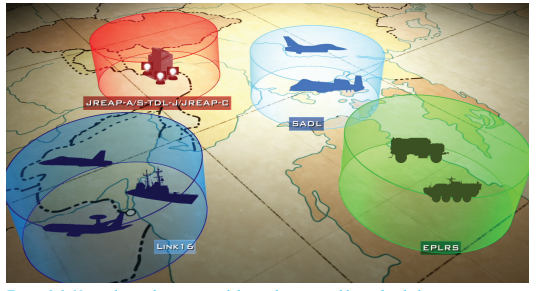 Segregated networks
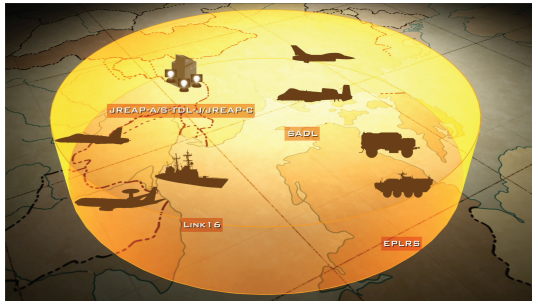 After employing a Tactical Gateway
PPLI
Precise Participant Location and Identification (PPLI) are J2.# messages.
Picture two Network Participation Groups (NPG 5 and 6) during which Link 16 units (JUs) transmit their precise location, identification, fuel and weapons status, and communications data. Here.. controlling units use NPG 6, PPLI and Status, Pool B; and controlled units such as fighter aircraft use NPG 5, PPLI and Status, Pool A, to transmit more rapid position updates.