Link 16 features
Network and Nets
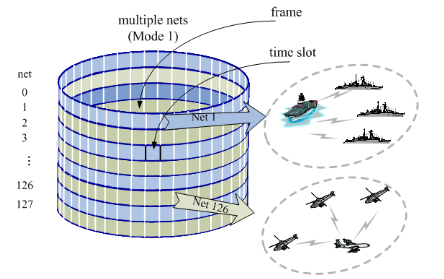 A Link 16 network is a collection of participants in synchronization; i.e the superset of all time slots and all users in sync. It may consist of one or more nets.
A net is a subset of the network's time slots and its particular users. Link 16 nets are differentiated by their frequency-hopping patterns.
In theory a Link 16 network can have up to 127 nets (0 - 126). Typically no more than three to six are ever utilized at one time during network execution.
Transmission types
Link 16 transmits data words (3, 6 0r 12 per 7.8125ms time slot). A Link 16 data word is analogous to a Link 11 frame and contains 70 bits of data.
Four types of transmissions are possible:
- Fixed Word Format (FWF)
- J-series messages are always sent in FWF
- Free Text (FT)
- Variable Message Format (VMF)
- Round-Trip Timing (RTT)
TDMA
The Link 16 Time Division Multiple Access (TDMA) terminal function uses time interlacing (time slots) to provide multiple apparently simultaneous nets. Time slots are 7.8125 milliseconds (ms), or 1/128 second, in duration.
nodelessness
A node is a unit required to maintain communications. On a Link 11 net, for example, the NCS is a node. If the NCS goes down, the link goes down. In Link 16 there are no nodes. Time slots are pre-assigned to each participant, and the link will function regardless of the participation of any particular unit.
security
In Link 16 both the message and the transmission are encrypted.